
Originally written in 2012. Remastered in 2026.
An end is a new beginning.
So let’s plan and start our beginning at the end.
By the time we reach Habit 7, we’ve explored six habits that help us live, work, and interact with others more effectively.
We learn to take responsibility for our choices. We define what we want to achieve. We put our priorities into action. We seek mutual benefit, understand others, and create something better together.
But at some point, we need to pause. To rest. To reflect. To replenish ourselves before continuing on our path.
It’s time to sharpen the saw.
Because becoming more effective isn’t simply about doing more. It’s also about maintaining ourselves so we can continue doing what matters.
“Every day is a new beginning, with new opportunities waiting. Be ready when they come.” – Max
The Habit of Renewal
This used to be one of the pictures i woke up to every day.
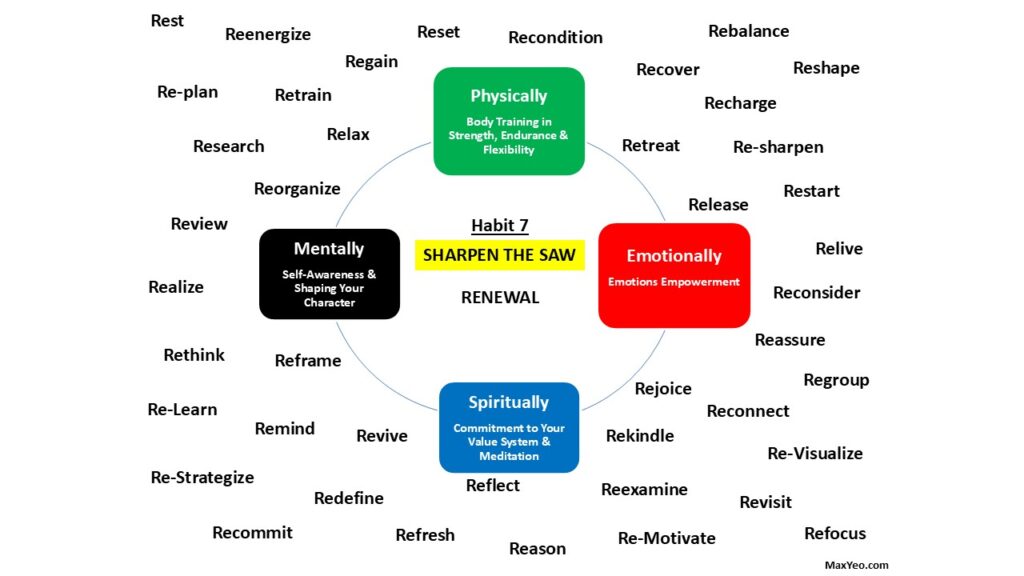
Choose one thing to do, and you may find yourself feeling better physically, spiritually, mentally, or emotionally.
The idea is simple. We can keep working with the tools we have, or we can take the time to maintain and improve them.
And what is the most important tool we have?
Ourselves.
In order to execute actions or operate at our full capability, we need to take care of our capacity too.
Covey describes four dimensions of renewal:
Physical: caring for our body and energy.
Spiritual: connecting with our values and sense of purpose.
Mental: continually learning and developing our minds.
Social/Emotional: building meaningful relationships and renewing our emotional well-being.
Each dimension contributes to our overall effectiveness. Neglect one for too long, and we may eventually feel the effects elsewhere.
Let’s look at each one.
1. Physical Dimension: Stay Healthy, Keep Fit, and Optimise Energy
Having a physically healthy body helps us carry out the activities we want to do. It affects our energy, endurance, mobility, and ability to keep going when things get demanding.
Think about the things we want to accomplish. How much easier would they become if we had more energy to work with? And how much harder would they feel if we were constantly tired?
This is where i see a connection with Habit 1 – Be Proactive. When we lack energy, even taking the initiative can feel like a chore. Sometimes, what sounds like a lack of time may actually be a lack of energy.
We tell ourselves:
“I don’t have the time.”
“I’m too tired.”
“I just can’t be bothered.”
The reasons may differ, but our physical condition can influence how willing and able we are to act.
In the book, Covey recommends maintaining our physical well-being through proper nutrition, sufficient rest, and regular exercise, across three areas:
Endurance – aerobic exercise to improve cardiovascular efficiency.
Flexibility – stretching to maintain and improve our range of movement.
Strength – resistance training, weightlifting, or other exercises that build muscular strength.
These aren’t simply about looking fit. They’re about maintaining the physical resources that allow us to live and perform more effectively. The right activities will differ depending on our age, health, abilities, and circumstances – the important thing is to keep our bodies moving and give them the care they need.
i’ll be covering more of this in my Health and Energy category.
i used to think i had a god-like body. Twenty-plus years of working hard, playing hard, and sleeping little – and feeling none the worse for it. Until that god left my body sometime in my mid-thirties. 😆
2. Spiritual Dimension: Leadership in Our Lives
i’m not a religious person, but i believe we’re all connected to something greater than ourselves.
For me, the spiritual dimension is about finding our inner grounding – our values, our purpose, and the things that give our lives meaning.
In the book, Covey suggests activities such as prayer, meditation, immersing ourselves in great literature or music, and connecting with nature. These activities may look different for different people. What matters is finding ways to reconnect with ourselves and what we believe in.
And when we feel lost, perhaps we can begin with three simple steps.
Remember. Think back to moments when we felt happy, excited, or genuinely positive about life. What were we doing? Who were we with? What made those moments meaningful? Sometimes it starts simply with paying attention – to the sounds around us, to nature, even to silence – before we can hear what our memories are telling us.
Reflect. Take a closer look at our motives. Why are we pursuing what we’re pursuing – because it matters to us, or because we believe it’s what we’re supposed to do? A purposeful life doesn’t necessarily mean having one grand mission. Sometimes it begins with understanding what matters to us and making choices that reflect it.
Release. Learn to let go of worries that we cannot resolve by worrying about them. Some concerns require action. Others require acceptance. And some simply need time. We may not control everything that happens, but we can decide how much of our attention we continue to give it.
In short: Remember what matters. Reflect on our motives. Release what we cannot control.
For me, spiritual renewal is also a reminder that we have a part to play in shaping our lives.
i once picked up a line from Tony Robbins that’s stuck with me since: “Everyone has faith, even if yours doesn’t have a name.”
3. Mental Dimension: Continual Learning
Most of our formal education happens during the early years of our lives. But learning shouldn’t end when school ends.
Life is a continual learning process. When we stop learning, we stop growing.
Funny enough, i think i’ve read more books after my Polytechnic days than during them. These days, i probably learn more chatting with Ai than i do chatting with most humans. 😅
That’s not a knock on people. Ai brings a kind of thoroughness to learning that’s hard to get elsewhere – ask it anything, from any angle, as many times as you want, and it won’t get tired of you. It’s less a teacher and more a library that talks back.
Which brings me to how different this all used to be.
i was born before the internet went public. Knowledge acquisition back then meant taking a bus and a train to the nearest library.
Then using what was probably a 386 running MS-DOS to search where my section of interest was shelved, then moving to the location to scan title after title to see what caught my eye.
And photocopying the pages i thought i needed, at a few cents apiece. i even photocopied parts of an encyclopedia once – we couldn’t afford the full set back then, but i was already a kid with far too many interests for his own good.
An afternoon could disappear just flipping pages looking for one answer. And i am still not home yet.
These days, anyone can search online and learn what they want in seconds – text, video, lectures from experts on the other side of the world.
i used to say “Life and Internet are my teachers” a lot. These days it’s “Life, Internet, and AI are my teachers.”
Read broadly. Explore unfamiliar subjects. Challenge our assumptions. Learn from people whose experiences differ from our own. And don’t limit learning to books or courses – we can learn from conversations, mistakes, experiments, work, and everyday experiences. The important thing is to remain curious.
Write to Think
i don’t actually keep a handwritten journal these days, but fun fact – i’m genuinely in love with my own handwriting. Back in the era when laptops were still a luxury, i filled stacks of foolscap and A4 paper by hand.
After that, almost everything moved to Microsoft OneNote, which became my main archive for years. That’s actually the raw material i’m feeding into my Obsidian setup now, as i work out how to properly build my digital brain.
Writing gives us an opportunity to slow down and examine what is happening in our minds. Sometimes an idea feels perfectly clear until we try to put it into words. Sometimes writing helps us discover what we actually think. And sometimes it helps us notice connections we might otherwise have missed.
Writing is slow. And maybe that slowness is exactly what helps our brain process things more deeply. These days the trend is to just talk – record our speech, transcribe it in real time, skip the step of putting it into our own words. It’s efficient. But it’s worth asking:
Are we also outsourcing the thinking itself?
If we stop doing the slow, effortful part of turning a thought into words, we may lose some of the mental muscle that process builds. Convenience is not the same as capability, and it’s worth noticing when we’re trading one for the other.
It can improve our ability to think clearly, reason accurately, and communicate effectively.
Writing isn’t simply a way to record what we know. It can also be a way to discover what we know.
Choose What We Feed Our Minds
Be aware of what our minds are consuming. Are we learning something new, or simply consuming more of what we already know? Are we challenging ourselves, or reinforcing our existing beliefs?
i’d rather be educated than merely entertained. But that doesn’t mean entertainment has no value – there is education in entertainment too, if we’re willing to look for it.
Take dramas, for instance. My wife and i watch a fair bit together, and i get fully immersed. My mum used to say the TV sucked my soul in whenever she caught me watching. Maybe to her it looked like just another story.
To me, it was never just a story. It’s closer to solving a puzzle – picking up on the interconnectedness between characters, choices, and consequences, and trying to predict what happens next before the story gets there.
Maybe it’s also because i have a deep interest in psychology and human behaviour, especially around influence and manipulation. Watching how a character gets another to do something, or how a lie unravels under pressure, is its own kind of study. 😏
There’s also the craft itself to study: videography, camera angles, pacing, character writing, facial expressions, gestures, and presentation skills. Even the odd survival lesson, should zombies ever become a real problem.
Oh, and lighting too. i never used to care about it, until i had to shoot my own YouTube videos and realised how much it actually shapes a scene.
i think my own storytelling has improved because of all that exposure to different stories too.
i used to tease the NSFs i worked with, as their instructor and IC – “you don’t watch K-dramas, so what do you even talk to girls about?” These days it’s probably C-dramas too, thanks to ZLH. #iykyk 🤭
As Walt Disney once said: “I would rather entertain and hope that people learned something than educate people and hope they were entertained.”
The point isn’t to turn every moment into a lesson. It’s to remain open to learning, wherever it may come from.
The more we learn, the more we realise how much we don’t know. Socrates put it more simply: “The only true wisdom is knowing we know nothing.”
It’s humbling, too, how fast knowledge and tools move on. i was doing some spring cleaning and realised i’d outlived a few programming languages without even noticing – they’d quietly gone the way everything eventually does…
4. Emotional Dimension: Feel Better to Be Better
Our emotions influence how we think, how we behave, and how we interact with others.
Think about Habit 4 – Think Win-Win. Habit 5 – Seek First to Understand, Then to Be Understood. And Habit 6 – Synergize. All three rely heavily on our ability to work with other people, and our emotional state can influence how well we do that.
When we’re frustrated, we may become impatient. When we’re anxious, we may become defensive. When we’re feeling good, we may find it easier to be generous, curious, and open to other perspectives.
We cannot always choose how we feel – some emotions arise before we’ve had time to think about them. But we can learn to recognise them, understand what may be contributing to them, and choose how we respond.
Renewing our emotional state doesn’t always require a major change: a little rest, a change of environment, a meaningful conversation, a walk outside, or simply a moment to breathe before reacting.
Sometimes it works the other way round too – be better to feel better. One area worth exploring is the relationship between our physiology and our emotions – how our posture, movement, and breathing can influence how we feel.
Try lifting your shoulders. Breathe deep. Or whatever happens, put a smile first.🙂
Problem = Opportunity to Shine. Either i seize the day (Carpe Diem!) or i’ll learn something and crush it the next time.
Still can’t shake it off? Channel a bit of the Joker: “Why so serious?” 😄
Change the body first, and the feeling sometimes follows. We may not control every emotion that arises, but we can learn to work with it.
And feeling better isn’t only about managing the hard emotions. Tony Robbins makes a useful distinction here – between the Science of Achievement and the Art of Fulfillment. Chasing success isn’t enough on its own. To actually feel good about what we achieve, we have to learn the art of feeling fulfilled by it, not just the mechanics of getting there.
5. Social Dimension: Improving Our Interactions with People
Covey groups the social and emotional dimensions together, and i understand why. A significant part of our emotional lives is shaped by the relationships we have with the people around us – the conversations we have, the support we receive, the conflicts we experience, the people who encourage us, challenge us, or drain our energy.
Think about a good conversation. We begin feeling frustrated or overwhelmed. Then we speak with someone who listens, understands, or offers a different perspective. By the end, we feel lighter. Nothing about the original situation has necessarily changed. But something within us has.
The right interaction can change how we experience a situation. And the reverse is true too – a difficult interaction can leave us feeling frustrated long after it’s over.
This is why i see social interaction as something that touches all four dimensions, not just one:
Our physical condition can influence our patience and energy. Our spiritual values can influence how we treat others. Our mental models can influence how we interpret what they say. Our emotional state can influence how we respond.
And the people around us can affect all these aspects of ourselves in return. We are constantly influencing and being influenced by the world around us.
Maybe that’s why we’re all introverts until we meet the ones we want to share our world with.
This brings us back to the earlier Habits. We cannot always control how others behave, but we can take responsibility for our responses. We can seek to understand before trying to be understood. And we can look for ways to create better outcomes together.
Sometimes renewing ourselves means spending more time with the people who bring out the best in us. Sometimes it means having a difficult conversation. And sometimes it means recognising when we need distance.
Improving our relationships isn’t about pleasing everyone. It’s about learning to interact with others in ways that are healthier for everyone involved.
Renewal Is a Continuous Process
Renewal isn’t something we do once and finish.
We don’t exercise once and become fit overnight, or remain fit forever.
We don’t learn one new thing and remain knowledgeable forever.
We don’t find our purpose once and never question it again.
And we don’t build a meaningful relationship without continuing to nurture it.
Life changes. Our circumstances change. Our needs change. What worked for us in one season of life may not be what we need in another.
As Tony Robbins puts it: “if we’re not growing, we’re dying.”
That’s why renewal requires us to keep checking in with ourselves. What needs attention? What have we been neglecting? What is working? What needs to change?
Sometimes we need to rest. Sometimes we need to learn. Sometimes we need to reconnect. And sometimes we need to let go of something that no longer serves us.
Even the useless or silly things of our past still shape us forward – the photocopied encyclopedia pages, the dramas, the languages we’ve quietly outgrown. Nothing really goes to waste.
The important thing is to recognise what we need and take action.
Sharpen the Saw, Then Begin Again
Looking back at the seven Habits, we can see how they connect.
Habit 1 teaches us to take responsibility for how we respond.
Habit 2 helps us define what we want our lives to stand for.
Habit 3 teaches us to put our priorities into action.
Habit 4 reminds us to seek mutual benefit.
Habit 5 teaches us to understand others before trying to influence them.
Habit 6 shows us how to use our differences to create something better together.
And Habit 7 reminds us to renew ourselves so we can continue doing all of this.
The first six Habits help us become more effective. The seventh helps us sustain that effectiveness.
But renewal isn’t simply about returning to where we were. With each cycle, we have the opportunity to learn something new, gain a different perspective, and become better equipped for what comes next.
The goal isn’t to keep moving without stopping. It’s to know when to move, when to pause, and when to renew ourselves.
So here’s where it actually starts.
Not with all seven habits at once. Not with a perfect plan. Just one small, honest choice, today.
Pick a dimension. Pick one thing. A walk. A page in a journal, or just an honest conversation with yourself. A conversation with someone who matters to you. Ten minutes of quiet before you let the day in.
Because every ending gives us an opportunity to begin again. And every new beginning gives us another opportunity to become a better version of ourselves.
Get unstuck. Restart. And begin again.
Previous Habit: Synergize – The Principle of Creative Cooperation
P.S. What can you do today to renew yourself – physically, spiritually, mentally, emotionally, or through the people around you?