
First Things First: Managing our resources for their highest and best use.
Habit 1 taught us that we are responsible for how we respond to life.
Habit 2 taught us to begin with the end in mind, to decide where we want to go before deciding how to get there.
Habit 3 brings those ideas into reality.
We know what matters.
We know where we want to go.
Now we have to decide what deserves our attention today.
That is where First Things First comes in.
Leadership Before Management
There is an important distinction between leadership and management.
Leadership decides what the first things should be.
Management makes sure those things get done.
We can become incredibly efficient at completing tasks that should never have been our priority in the first place.
We can fill our days with activity and still make very little progress toward what actually matters.
So before asking: “How can we get more things done?”
We should first ask:
“What are the right things to get done?”
Habit 3 is about bringing our daily actions into alignment with the direction we established in Habit 2.
Time Management? Not Really.
i’ve always found the term Time Management slightly misleading.
We don’t actually control time.
We can’t stop it.
We can’t save it.
We can’t store today’s unused hours and spend them tomorrow.
Everyone gets the same 24 hours a day — 86,400 seconds.
What differs is how we choose to use those moments.
So, to me, time is a measurement, not a resource.
What we manage is not time itself, but ourselves within time.
Stephen Covey describes the essence of time management as:
Organizing and executing around priorities.
And I think that’s the real lesson.
We aren’t managing time.
We’re managing ourselves within time.
The question isn’t: “How do we find more time?”
It’s:
“What deserves the time we have?”
The Four Quadrants
Covey’s Time Management Matrix organizes our activities according to two dimensions:
Importance and Urgency.
📌 INSERT YOUR ORIGINAL “TASK PRIORITY MATRIX / REWARDS VS EFFORT MATRIX” IMAGE HERE
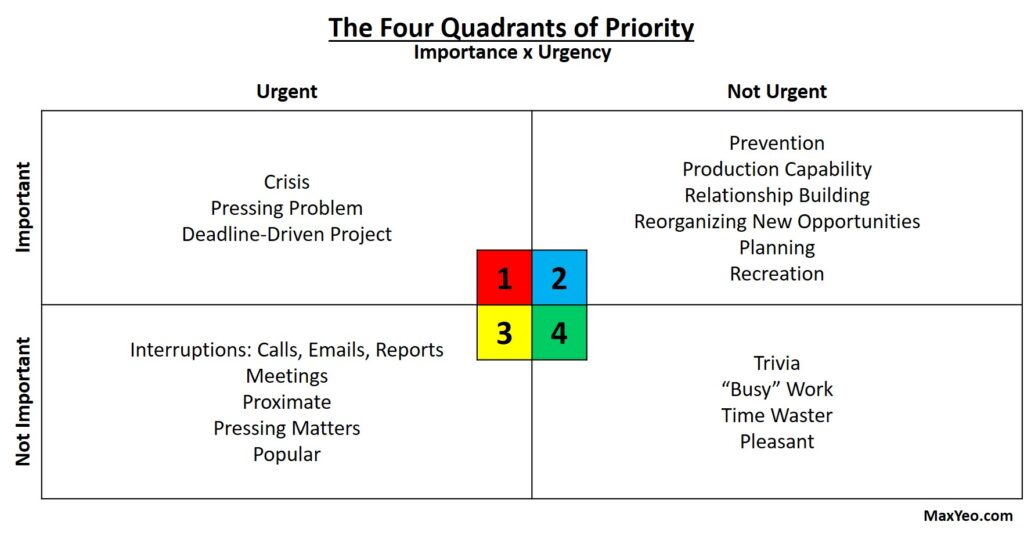
Quadrant 1: Important & Urgent
These are the things that require immediate attention:
- Crises
- Pressing problems
- Deadlines
- Emergency situations
We can’t simply ignore Quadrant 1.
Some things genuinely need to be dealt with now.
But if our lives are constantly dominated by Quadrant 1, we eventually find ourselves living in a cycle of pressure, stress, and reaction.
Quadrant 2: Important But Not Urgent
This is where things become interesting.
Quadrant 2 includes:
- Prevention
- Planning
- Preparation
- Relationship building
- Recognizing opportunities
- Personal development
- Recreation and renewal
Nothing here is necessarily screaming for our attention.
And that’s exactly why these things are so easy to postpone.
There is no immediate crisis when we skip exercise today.
There is no emergency when we don’t plan for next month.
There is no alarm going off when we neglect an important relationship.
But these things accumulate.
“Quadrant 2 is where we invest today to create a better tomorrow.“
Quadrant 3: Not Important But Urgent
This is where things can get deceptive.
- Calls.
- Emails.
- Meetings.
- Interruptions.
- Other people’s pressing matters.
They may feel urgent because someone wants our attention now.
But urgency does not automatically make something important.
We need to learn to distinguish between:
“This needs attention.”
and
“This deserves our attention.”
They are not always the same thing.
Quadrant 4: Not Important & Not Urgent
These are the activities that consume time without contributing much value:
- Time wasters
- “Busy” work
- Trivia
- Mindless distractions
There is nothing wrong with taking a break.
Rest and recreation can actually belong in Quadrant 2 when they help us renew ourselves.
The question is whether what we’re doing is renewing us or merely consuming us.
Why Quadrant 2 Matters
The irony is that Quadrant 2 often contains the things that matter most precisely because they aren’t urgent.
When something becomes urgent, we have already lost the luxury of preparation.
Prevention happens before the problem.
Planning happens before the deadline.
Relationship building happens before we need someone’s help.
Learning happens before we need the skill.
Rest happens before burnout.
Quadrant 2 is where we create capacity instead of constantly responding to consequences.
That’s why i believe we should spend more of our lives there.
Not because Quadrant 1 can disappear.
But because good Quadrant 2 decisions can prevent some Quadrant 1 problems from ever happening.
My Rewards vs Effort Perspective
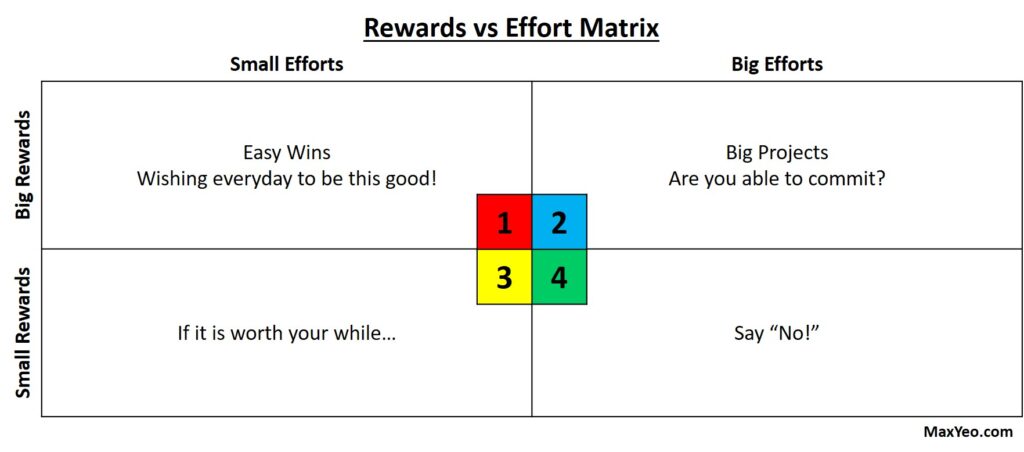
The Four Quadrants help us ask: “Is this important? Is this urgent?”
But i found myself wanting to ask another question: “Is this worth the effort?”
That’s where my Rewards vs Effort Matrix comes in.
A small effort can sometimes create a surprisingly large reward.
Likewise, something can consume enormous amounts of our time and energy while producing very little in return.
This gives us another perspective when deciding where to invest our time and energy.
Not everything important needs to be easy.
Some things are worth a tremendous amount of effort.
But our energy is limited, so we should be conscious of where we invest it.
First Things First isn’t about doing everything.
It’s about choosing what deserves to be done.
Four Keys to Weekly Quadrant 2 Living
Covey’s approach helped me think about managing our priorities on a weekly basis.
i broke it down into four practical steps.
1. Identify Our Roles
Before we decide what our goals are, we need to understand the roles we play.
We may be:
- Individuals
- Partners
- Parents
- Children
- Friends
- Professionals
- Leaders
- Colleagues
Each role represents a different area of responsibility.
And each role may have something important that deserves our attention.
2. Select Our Goals
Once we understand our roles, we can identify what matters most.
Instead of creating an enormous list of things we could accomplish, choose a small number of meaningful goals.
Prioritization means deciding what matters enough to receive our limited attention.
3. Schedule Our Goals
There is a time for everything.
But not everything can happen at the same time.
If something genuinely matters, we need to give it a place in our schedule.
Otherwise, the urgent will happily consume all the available space.
A goal without time allocated to it can easily remain a good intention.
4. Adapt Daily
Planning doesn’t mean everything will go according to plan.
Life happens.
Unexpected problems appear.
Priorities change.
New information arrives.
So we should Review, Reflect, and Readjust.
A good plan gives us direction without making us rigid.
What Gets in Our Way?
If we struggle to organize and execute around our priorities, perhaps the problem isn’t simply “time.”
We can ask ourselves:
Is it our inability to prioritize?
Do we actually know what matters most?
Is it our inability or lack of desire to organize those priorities?
Do we know what matters but fail to create the structure to support it?
Or is it a lack of discipline to execute according to the priorities we have already set?
Knowing the problem helps us address the right problem.
Turning Priorities Into Actions
Over the years, I developed my own ABCD framework to think about the four forces that influence how we move from intention to execution.
Attitude. Belief. Courage. Desire.
i explore the framework in greater detail here:
My ABCD to Performance (Taking Action)
First Things First Is About Choice
Habit 3 brings the first three habits together.
Be Proactive: We are responsible for our responses.
Begin With The End In Mind: We decide where we want to go.
First Things First: We organize our actions around what matters most.
The real challenge isn’t having enough things to do.
“We will always have more things to do than we have time for.”
The challenge is deciding what NOT to do.
Because every time we say yes to something, we are also saying no to many more things.
We don’t have to say yes to everything that matters. We have to decide what matters most.
Our priorities are revealed not by what we say matters, but by what we consistently give our time, energy, and attention to.
And sometimes, putting first things first simply means having the courage to say:
No.
So perhaps the question we should carry forward is:
“What deserves our attention today?”
Related Habits
← Habit 2: Begin With The End In Mind
We can’t prioritize effectively if we don’t know where we’re going.
→ Habit 4: Win-Win Thinking
Once we learn to manage ourselves effectively, we can begin applying these principles to our relationships with others.
P.S. If we don’t have our Private Victory, how will we have a Public Victory? 😄