
Originally written in 2012. Remastered in 2026.
The first three habits focused on our Private Victory.
Habit 1 taught us to take responsibility.
Habit 2 taught us to begin with the end in mind.
Habit 3 taught us to put first things first.
Now we move from Private Victory to Public Victory.
Because we don’t live in isolation.
We are constantly exchanging value with the world around us – directly through people, and indirectly through the products, services, and systems people create.
We eat food.
We use electricity.
We access the Internet.
We use products and services created by people we may never meet.
Sometimes we exchange money.
Sometimes we exchange knowledge.
Sometimes we exchange experience.
Sometimes we exchange stories.
And whenever value moves between us, there is an opportunity for us to be better off because of the interaction.
But what does that actually mean?
Who wins? Who loses? And what does the outcome mean for us?
Win, Lose & Meaning
When we interact with others, there are different possible outcomes.
| Me | The Other Party | Meaning |
|---|---|---|
| WIN | WIN | We are better off because of the interaction. |
| WIN | LOSE | I benefited; the other party did not |
| WIN | – | I know I benefited, but I don’t know their outcome |
| LOSE | WIN | The other party benefited; I did not |
| LOSE | LOSE | Neither of us benefited |
| NO DEAL | NO DEAL | We chose not to proceed |
The important thing to remember is that Win and Lose aren’t always as objective as they appear.
We may know that we won, but we don’t always know whether the other party won or lost.
People can place completely different values on the same interaction.
And the outcomes can be completely different too.
Consider a course that costs a few thousand dollars.
One person may feel that paying a few thousand dollars should somehow change their life without them having to do much.
Another may just get one idea from that course and turn it into a million-dollar business.
Someone else may consume the entire course, take hundreds of pages of notes, and never actually do anything with it.
Same course. Different outcomes.
Sometimes we even need to be educated to recognise the value we have received.
And if we don’t get the outcome we wanted?
We Win or We Learn.
A loss can still become valuable if we learn from it.
Win-Win
So what does Win-Win actually mean?
To me, it can be surprisingly simple:
We are better off because of the interaction.
We don’t necessarily get everything we want.
We don’t necessarily receive the same thing.
And we don’t even have to value the outcome in exactly the same way.
What matters is that the interaction creates value for us.
Win-Win doesn’t mean everyone gets everything.
It means we find a way for us to be better off together.
Think WIN-WIN: The Habit of Interpersonal Leadership
It is human nature to think:
WIIFM?
“What’s In It For Me?”
There is nothing inherently wrong with looking after our own interests.
We should.
The problem begins when our interests are the only interests that matter.
Win-Win asks us to look beyond ourselves.
Not just:
What do i want?
But:
What matters to us?
And this requires us to understand what the other party values.
Because what we think is valuable may not be what they value.
That is where the real challenge begins.
From WIN-WIN to WIN-WIN-WIN
And this is where i started wondering if Win-Win could go one step further.
What happens when the value doesn’t stop with us?
For example, i think of Russell Brunson and his ClickFunnels – a sales funnel software company.
Russell benefits through subscriptions when entrepreneurs use his platform to sell their products and services.
Their customers benefit from the value those businesses create, especially during the lockdown.
And as entrepreneurs become successful, some eventually become collaborators, partners, contributors, or speakers within the same ecosystem.
Funnel Hacking Live, anyone?
The value doesn’t have to stop with the original transaction.
I win.
You win.
Others win.
That’s how I think about Win-Win-Win.
Not simply:
What do I benefit from?
Not only:
What do you benefit from?
But:
What did our interaction enable you to do for someone else?
The best relationships don’t merely create value between us.
They create value through us.
The relationship becomes a multiplier of value.
And perhaps that is one of the greatest forms of Win-Win.
No Deal
But not every interaction can produce a Win-Win outcome.
Sometimes we simply aren’t a good fit.
Our expectations may not align.
Our interests may conflict.
The timing may be wrong.
Or we may realise that continuing the interaction will create more problems than value.
That’s where No Deal comes in.
“We choose not to proceed, avoiding Lose-Lose.”
No Deal isn’t necessarily a failure.
Sometimes walking away is the better outcome.
“We’re not a good fit.”
It sounds like a marketing message.
But there’s truth in it. 😆
Walking away can sometimes protect us from a Lose-Lose outcome.
The Five Dimensions of Win-Win
Win-Win doesn’t happen simply because we say we want everyone to win.
There needs to be a foundation that supports it.
Covey describes five dimensions:
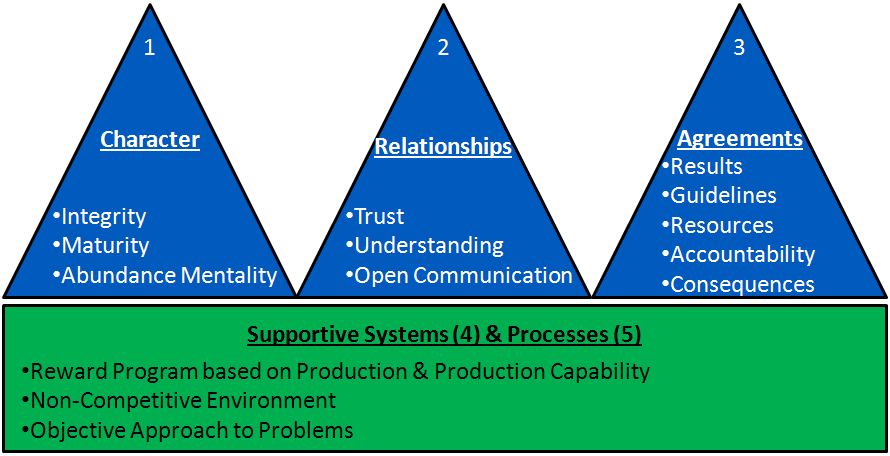
1. Character
Character is the foundation.
Integrity
We need to know what we stand for.
And more importantly, we need to live according to it.
Integrity means making commitments and keeping them – to ourselves and to others.
Because if our words and actions don’t match, why should anyone trust us?
Maturity
Maturity is the balance between courage and consideration.
We need enough courage to express what we want.
But we also need enough consideration to recognise what others want.
Too much courage without consideration can become selfishness.
Too much consideration without courage can leave us constantly giving in.
Win-Win requires both.
Abundance Mentality
An abundance mentality starts with the belief that there is enough opportunity, success and value for more than one person.
If we believe there is only one winner, every interaction becomes a competition.
If we believe there can be multiple winners, we start looking for ways to create more value instead of fighting over the existing value.
2. Relationships
Character creates the foundation.
Relationships create the connection.
And relationships need trust.
Trust makes mutual learning possible.
It allows us to communicate openly.
It makes it easier to discuss problems before they become bigger problems.
It also allows us to understand another person’s perspective rather than simply trying to convince them of ours.
A strong relationship doesn’t only ask:
What can we do for each other?
It can also ask:
What can our relationship enable beyond ourselves?
Because the value of a relationship isn’t always limited to the people inside it.
Sometimes the greatest value is what happens because those people connected in the first place.
3. Agreements
Good relationships still need clear agreements.
Good intentions alone aren’t enough.
Covey identifies five elements of a Win-Win Agreement: Desired Results, Guidelines, Resources, Accountability, and Consequences.
i made one small change when revisiting my original notes.
i changed Desired Results to End Results and moved it to the end, because it suits my own thinking better and changes the approach slightly…
A desired result can reflect what one party wants.
An end result asks us to step back and consider what we are ultimately trying to achieve together.
It also gives us a rather nice acronym: G.R.A.C.E.
Guidelines: What principles, boundaries or rules will guide us?
Resources: What do we need to accomplish the objective?
Accountability: Who is responsible for what?
Consequences: What happens when things go well and what happens when they don’t?
End Results: What are we ultimately trying to achieve?
And perhaps a good agreement requires a little grace from everyone involved – a balance of gives and takes. 😆
And End Results is at the bottom because sometimes, it is the bottom line.
Sometimes, the strongest answer isn’t an explanation.
We can talk about what we are capable of.
We can explain what went wrong.
We can defend our decisions.
Or we can produce the result.
A footballer can spend weeks explaining a goal drought.
Or they can score the winning goal.
Sometimes, results speak louder than most things.
To produce good results, we need to look at the systems that produce those results.
4. Systems
Even good people can struggle inside a bad system.
We often tell people: “Work together.”
But then create systems that reward them for competing against one another.
We say: “Help the team.”
But measure only individual performance.
We say: “Create value together.”
But reward only whoever gets the biggest piece.
This is why systems matter.
Structure Drives Behaviors.
If we want Win-Win behaviour, the environment needs to support it.
Reward systems should consider both individual and collective performance.
Processes should encourage cooperation rather than unnecessary internal competition.
A Win-Win mindset is difficult to sustain inside a system designed for Win-Lose.
Zooming In and Out
A system provides the structure that supports how things work.
But a system can also be viewed as a process of processes.
We can zoom out and look at the system as a whole.
Or we can zoom in and see smaller systems and processes working within it.
A bicycle is a simple example that we can look at as one system.
Or we can zoom in and see smaller systems within it – the wheels, the pedals and chain, the steering mechanism, and so on.
Each can be examined on its own, yet they work together to form the bicycle.
Systems provide the structure. Processes determine how the work actually happens.
And we can keep zooming in and out depending on what we are trying to understand.
5. Processes
If systems provide the structure, processes are how things actually happen within that structure.
A process is not simply a series of steps we follow.
It is also a cycle of action, feedback and improvement.
We perform, experience what happens, learn from it, and use that learning to influence our next performance.
Performance creates experience.
Experience enables learning.
Learning improves future performance.
Together, they form a reinforcing loop. And the cycle continues.
This means we shouldn’t only ask:
Did we get the result we wanted?
We should also ask:
How did we get there?
Because the process we use to produce a result can influence what happens the next time we run it.
A process that creates learning can improve future performance.
A process that creates waste, dependency or conflict can reproduce those problems too.
And this is where Systems and Processes connect.
A Win-Win process achieved through a Win-Lose system isn’t really Win-Win.
The process may encourage cooperation, but if the system ultimately rewards one party at the expense of another, the structure works against the process.
So Win-Win isn’t only about what we achieve.
It is also about how we achieve it.
The means should support the ends.
We reap what we sow.
And this brings us back to the first three habits.
We take responsibility for how we respond.
We decide what matters.
We put those priorities into action.
Now we need to consider how our actions affect the people around us.
Win-Win Doesn’t Mean Everyone Gets Everything
One thing I think is important to clarify:
Win-Win does not mean everyone gets everything they want.
That’s unrealistic.
Sometimes our interests genuinely conflict.
Sometimes resources are limited.
Sometimes the timing is wrong.
Sometimes the relationship itself isn’t healthy.
And sometimes, the best answer is simply:
No Deal.
Walking away isn’t necessarily losing.
It can be recognising that forcing an agreement would create a worse outcome for everyone.
A short-term loss can sometimes create a long-term win.
And a short-term win can sometimes become a much bigger loss later.
The best we can do is read reality as accurately as possible and respond accordingly.
Outcome is 90% Response.
Before We Create Win-Win, We Need to Understand
And this brings us back to the question we started with:
How can we create Win-Win if we don’t understand what the other party values?
We can’t.
We may think we are creating value.
We may believe we are giving someone what they need.
We may even believe they have won.
But ultimately, we don’t get to decide what someone else considers valuable.
We need to understand.
And understanding requires attention.
Which brings us to the next habit:
Seek First to Understand, Then to Be Understood.
P.S. Perhaps the better question is “What can our next Win-Win relationship enable beyond ourselves?“
Related Posts
Habit 3: Put First Things First
Habit 5: Seek First to Understand, Then to Be Understood